Torch, LLC has launched its TRCH utility token alongside staking and on-chain referral features within the Torch-RWA platform. The release introduces user access tools and incentive mechanisms designed to support ecosystem participation while maintaining a compliance-focused framework and clear distinction between utility token functions and future regulated real-world asset offerings.
Ethereum-based token goes live alongside user portal, supporting participation in Torch’s real-world asset tokenization ecosystem.
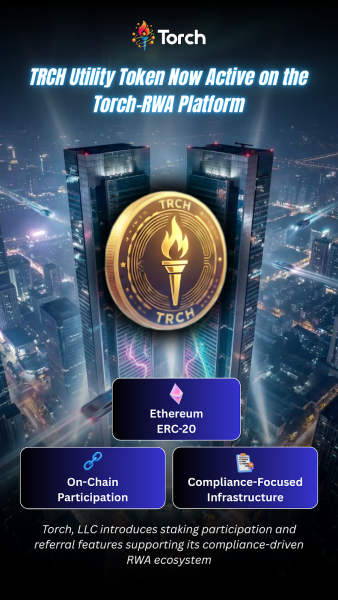
Atlanta, GA 30338, Georgia, United States, 19th Feb 2026 – Torch, LLC (“Torch”) today announced the official launch of its native utility token, TRCH, and the activation of the staking and referral rewards programs. TRCH is designed to support platform access, fee functionality, governance participation, and ecosystem incentives across the Torch-RWA Tokenization Platform, a compliance-driven marketplace for tokenized real-world assets (“RWAs”).
The launch follows Torch’s earlier announcements introducing Torch-RWA and outlining TRCH tokenomics and an in-house token distribution module conducted exclusively through the Torch-RWA landing page—an approach intended to provide transparent, phased distribution and reduce dependence on speculative third-party exchange listings.
“Today we go live,” said Eric McClendon, CEO of Torch, LLC, “users finally have a simple way to own, hold, and use TRCH tokens while we continue building out our regulated, real-world asset tokenization infrastructure.”
What Launch Day Includes
With this release, users can:
- Participate in staking rounds offering time-based TRCH incentives
- Use unique referral links to receive additional TRCH when their contacts participate in the token distribution module
- Access the Torch Token Distribution Module
- Connect their wallet (Metamask, Trust Wallet, etc.)
- Get the TRCH token using USDC (ERC-20, Ethereum Network)
- View and manage TRCH balances
- Take part in early governance and signaling on specified protocol parameters
TRCH is an ERC-20 utility token designed to power the Torch-RWA Ecosystem. The TRCH smart contract has been independently audited by CertiK, a blockchain security firm, as part of Torch’s focus on security and transparency. Torch-RWA has been listed on CertiK Skynet’s Top Emerging RWA Projects Leaderboard, as reflected on publicly available platform data, even prior to the marketplace’s full launch.
Staking: Lock TRCH, Receive Protocol Incentives
Torch has activated a round-based staking program that lets TRCH holders commit their tokens for fixed periods in exchange for additional TRCH token incentives, paid from a pre-allocated rewards pool.
On launch day, the staking program includes the following round parameters:
- 30-day round – 22% APY, 5% early-exit penalty
- 90-day round – 33% APY, 5% early-exit penalty
- 180-day round –44% APY, 5% early-exit penalty
- 365-day round – 66% APY, 5% early-exit penalty
In practical terms:
- Users choose a round, lock a chosen amount of TRCH, and see protocol-defined incentives accrue programmatically for the length of the lock-up.
- Rewards are paid in TRCH and can be harvested at any time during the staking period without unstaking; principal remains locked until maturity.
- If a user decides to exit early, an automatic penalty applies, and both the principal and any remaining rewards are adjusted accordingly.
All staking activity runs through smart contracts that apply security functions to prevent reentries, time-lock, safe-math APY calculation, reward harvesting, and penalties for early unstaking. Any user can stake or receive staking rewards, and all transactions are logged on-chain for audit and reporting.
Staking incentives are protocol-based utility mechanisms and should not be interpreted as interest, guaranteed returns, or investment performance.
“Staking is our way of rewarding early adopters who are willing to commit to the ecosystem,” McClendon said. “It’s simple to understand—lock TRCH, acquire TRCH—and use it on the Torch-RWA Platform.”
Referral Program: On-Chain Rewards for Growing the Network
Alongside staking, Torch is launching the TRCH Referral Program, giving users a straightforward way to receive extra TRCH for helping expand the user base.
Key elements:
- Every user receives a unique referral link tied to their wallet when they connect.
- When someone uses that link, and acquires TRCH tokens through our token distribution module, the referrer receives an on-chain, one-time TRCH token reward.)
- The referral rate is set on a program-wide basis, currently targeted at 5%, and is capped globally so that referral rewards can never exceed a defined share of total supply.
The system prevents self-referrals, contract-address referrals, and circular referral chains, and all relationships and payouts are tracked on-chain. Administrators can disable abusive relationships while leaving legitimate referrals untouched.
Referral rewards are paid only in TRCH, do not accrue interest, and do not represent any guaranteed rate of return. They are simply one-time, programmatic token rewards for user introductions that result in successful TRCH token acquisitions.
“The staking and referral programs are designed to reward participation, not speculation,” McClendon added. “If you help grow the user community or commit your tokens for a period of time, the system recognizes that with transparent, on-chain TRCH rewards.”
Continued Focus on Compliance and Future RWA Listings
Torch emphasized that today’s launch does not change its regulatory posture: any future RWA security-token offerings on the Torch-RWA Tokenization Platform will remain subject to applicable securities laws, jurisdictional eligibility rules, and formal offering documentation. Participation will be limited to verified users in permitted jurisdictions, and transfers of any security tokens will be controlled through on-chain identity and compliance checks.
Torch has indicated that the anticipated launch date for Torch-RWA is expected to be within the next 3 to 6 months, although this timeline may be subject to change. This development aims to further enhance the ecosystem’s compliance-driven infrastructure for tokenized real-world assets.
An updated Torch-RWA Whitepaper, detailing the marketplace architecture, TRCH utilities, staking workflow, referral logic, and the separation between utility tokens and regulated RWA tokens, is now available on the Torch-RWA website. Interested participants are encouraged to review the full Torch-RWA Whitepaper before engaging with TRCH or any future RWA offerings.
About Torch, LLC and Torch-RWA
Torch, LLC operates Torch-RWA, a blockchain-based marketplace for the compliant issuance, trading, and revenue automation of tokenized real-world assets. Torch-RWA integrates regulated security-token standards, automated KYC/AML enforcement, decentralized governance, and programmable finance to provide institutional-grade digital infrastructure for RWA tokenization.
For more information, visit https://torch-rwa.com.
Contact them via
Email: Jason@jmfcommunications.com
Visit Torch-RWA through
X (Twitter): https://x.com/Torchrwa
Telegram: https://t.me/torch_rwa
Instagram: https://www.instagram.com/torch_rwa/
Media Contact
Organization: Torch-RWA
Contact Person: Jason Feldman
Media & Communications
Phone: (470) 626-1055
Website: https://torch-rwa.com/
Email: Jason@jmfcommunications.com
Corporate Office – Torch, LLC
1050 Crown Pointe Parkway
Suite 500
Atlanta, GA 30338
United States
Disclaimer(s)
This press release is for informational purposes only and does not constitute an offer to sell or the solicitation of an offer to buy any securities, tokens, or other financial instruments in any jurisdiction. Any future offering of securities or digital assets will be made only by means of applicable offering documents and only to investors who meet all eligibility, suitability, and regulatory requirements.
Digital assets and tokenized securities are speculative and involve a high degree of risk, including possible loss of principal. There is no assurance that any tokenization initiative, financing plan, or development described herein will be completed as contemplated or will achieve any particular financial outcome. Statements in this release that are not historical facts are “forward-looking statements” subject to risks and uncertainties that could cause actual results to differ materially from those expressed or implied.
Forward-Looking Statements
This press release contains forward-looking statements within the meaning of the Private Securities Litigation Reform Act of 1995. Actual results may differ materially due to risks and uncertainties including regulatory approvals, financing conditions, construction timelines, and market adoption of emerging technologies.
Media Contact
Organization: Torch, LLC
Contact Person: Jason Feldman
Website: https://torch-rwa.com/
Email: Send Email
Address:1050 Crown Pointe Parkway
Address 2: Suite 500
City: Atlanta, GA 30338
State: Georgia
Country:United States
Release id:41592
The post Torch, LLC Launches TRCH Utility Token with Live Staking and On-Chain Referral Features on Torch-RWA Platform appeared first on King Newswire. This content is provided by a third-party source.. King Newswire makes no warranties or representations in connection with it. King Newswire is a press release distribution agency and does not endorse or verify the claims made in this release. If you have any complaints or copyright concerns related to this article, please contact the company listed in the ‘Media Contact’ section