By National Standard Finance LLC (www.NatStandard.com)

In emerging markets and higher-risk geographies, infrastructure projects often fail to reach financial close for a familiar reason: credit risk overwhelms otherwise sound economics. Even when demand is real and engineering is solid, lenders price political, convertibility, off-taker, and payment risks into margins, tenors, covenants, and reserve requirements often to the point where the capital structure becomes non-viable.

National Standard Finance LLC (NSF), a U.S.-based global infrastructure investment and advisory firm focused on sovereign and government-linked infrastructure and project finance, has long emphasized that “bankability” is engineered as much in the legal and credit architecture as in the technical design. As Russell Duke, President and CEO of National Standard Finance LLC, puts it: “Infrastructure does not fail due to lack of need—it often fails or is delayed due to poor structuring and lack of project fitted financing.”

Two of the most powerful—and most frequently misunderstood—tools for improving bankability in these environments are (1) sovereign guarantees 2) export credit agency (ECA) guarantees/insurance and 3) political risk insurance (PRI). Used correctly, they can compress pricing, extend tenor, increase leverage, and crowd in international liquidity. Used poorly, they can create unenforceable support packages, trigger hidden fiscal constraints, or undermine the credibility of the broader sovereign balance sheet.

This article provides a technical, transaction-oriented playbook for deploying these instruments in infrastructure loans and project finance.


1) Start with the risk map lenders actually underwrite

Before selecting a guarantee structure, build a lender-grade risk map across four buckets:

  1. Revenue/Off-taker risk: tariff affordability, demand volatility, off-taker credit quality, subsidy reliability, collection performance.
  2. Political/sovereign risk: change in law, termination, expropriation, contract sanctity, force majeure politicization.
  3. FX/convertibility and transfer risk: availability of hard currency, convertibility constraints, capital controls, payment routing.
  4. Construction and performance risk: EPC completion, cost overrun, technology risk, O&M continuity.

Guarantees do not “solve” all risks. They re-allocate specific risks to counterparties that markets will accept at lower cost of capital.


2) Sovereign guarantees: what they are—and what banks require to treat them as credit

A. The practical purpose

A sovereign guarantee is a government-backed credit support undertaking that shifts defined project obligations (typically payment obligations) onto the sovereign. In infrastructure finance, it is most often used to backstop:

  • Off-taker payment obligations (e.g., a state utility’s PPA payments)
  • Termination compensation under a concession/PPP agreement
  • Minimum revenue / availability payments for user-pay or hybrid projects
  • Foreign exchange availability and transfer undertakings (in limited forms)

When a sovereign guarantee is credible and enforceable, banks can underwrite to the sovereign (or sovereign-plus structure) rather than solely to a project company and a thinly capitalized off-taker.

B. Structural options banks recognize

In practice, lenders see four main sovereign-support “tiers,” in ascending strength:

  1. Letter of support / comfort (often not bankable as credit)
  2. Contractual undertaking in project documents (e.g., a government support agreement)
  3. Sovereign guarantee (standalone instrument, often ministry of finance/treasury executed)
  4. Direct sovereign borrowing / on-lending (highest credit clarity, but higher balance sheet impact)

The key is aligning the chosen instrument with what lenders can enforce, and what the sovereign can legally and fiscally support.

C. Documentation essentials that drive bankability

A sovereign guarantee becomes “financeable” when it contains the features credit committees look for:

  • Clear, unconditional payment obligation (avoid vague “best efforts”)
  • Defined guaranteed obligations (what exactly is guaranteed: debt service? availability payments? termination sums?)
  • Demand mechanics (notice, cure periods, payment timelines, payment account details)
  • Governing law and dispute resolution acceptable to lenders
  • Waiver of sovereign immunity for enforcement (scope matters)
  • Appropriation and budget mechanics (where relevant) and proof of legal authority
  • Consistency with negative pledge and pari passu frameworks in sovereign debt practice (to avoid structural subordination disputes in stress).

D. The fiscal reality: guarantees must fit the sovereign’s constraints

Many ministries will agree politically to “guarantee,” but later discover that:

  • parliamentary approvals are required,
  • contingent liabilities breach fiscal rules, or
  • the guarantee must be capped, time-bound, or limited to specified triggers.

Treat this as a design input, not an afterthought. A “partial” guarantee can still be bankable if it is precisely targeted—e.g., guaranteeing termination payments and political force majeure compensation while leaving ordinary operating performance with the project.


3) ECA guarantees and insurance: how to use them to unlock tenor, price, and liquidity

A. What ECAs typically cover

Export credit agencies support exports of goods/services from their home countries through:

  • Guarantees to commercial lenders (wrapping all or a portion of the loan)
  • Insurance policies covering commercial, financial, payment and/or political risks
  • Direct loans in some programs (less common, program-dependent)

In project finance, ECA support is valuable because it can provide comprehensive political + commercial risk cover and materially improve the debt package economics. As PwC notes, ECA products can cover political risk events such as exchange controls, expropriation, war, and similar disruptions that are hard or expensive to insure commercially.

Coverage percentages vary by program and structure; major ECA programs often cover a substantial portion of eligible exports and related financings, and can be structured as “comprehensive” cover (commercial + political) depending on the product.

B. The “ECA-enabled” project finance architecture

A standard ECA-supported infrastructure debt stack often looks like:

  • ECA-covered tranche (senior): tied to eligible imported equipment/services; priced and tenored on ECA terms.
  • Uncovered tranche(s): junior debt tranche, unsecured debt tranches, working capital facilities, DFI tranche, or institutional tranche (sometimes with separate credit enhancement).
  • Equity and subordinated capital: sponsor equity; mezzanine where needed.

The ECA tranche anchors the package: it sets a “floor” for tenor and a “ceiling” for overall risk premium, enabling the rest of the syndicate to participate on improved terms.

C. OECD Arrangement considerations (tenor and rules)

For many ECAs, terms are influenced by the OECD Arrangement on Officially Supported Export Credits, which governs key parameters of official export credit support (scope, forms of support, and limitations on terms). Recent reforms have expanded flexibility in certain cases (including longer tenors for specific categories under the Arrangement’s sector understandings).

Practical implication: you should design procurement and contracting early to preserve ECA eligibility, local cost rules, and content thresholds—otherwise you discover “too late” that the project cannot access the ECA tenor you modeled.


4) Combining sovereign guarantees and ECA support: the highest-leverage bankability move

The most bankable structures in higher-risk markets often combine:

  • ECA support to de-risk lender exposure on the imported-capex portion (up to 85% normally of import portion), and
  • Targeted sovereign support to de-risk public counterparty obligations (off-taker payments, lease payments, availability or user payments, termination compensation, key political undertakings).
    lender concerns:
  • “Will the government system pay and honor contracts?” (sovereign support)
  • “What happens if the country risk event prevents repayment?” (ECA political risk cover)

NSF’s advisory posture aligns with this integrated lens mobilizing “long-term capital from development banks, export credit agencies, and private lenders” as part of a financeable blueprint.


5) A step-by-step playbook to execute these credit supports in real transactions

Step 1: Decide what must be guaranteed—and what should not be

Over-guaranteeing creates fiscal and political resistance; under-guaranteeing leaves banks unconvinced. Focus sovereign support on non-diversifiable risks:

  • termination and political force majeure compensation
  • offtaker/availability payment obligations (if the revenue model depends on them)
  • limited FX undertakings where feasible

Use ECA cover to address export-related financing risk and political risk for lenders.

Step 2: Engineer the procurement and contracting to be ECA-eligible

ECA feasibility is often won or lost in procurement design:

  • allocate exportable equipment/services cleanly
  • structure EPC supply chains to meet content rules
  • ensure documentation supports ECA due diligence (KYC, environmental/social, anti-corruption)

Step 3: Align the government support agreement (GSA) and guarantee with lender remedies

Banks require a remedies path that is contractually coherent:

  • direct agreement / step-in rights where appropriate
  • termination payment waterfall and timing that matches debt amortization
  • clear interaction between concession termination and guarantee payment triggers

Step 4: Structure the intercreditor and security package around the ECA tranche

Common approaches include:

  • shared security with tranche-specific voting thresholds
  • separate facilities with coordinated enforcement triggers
  • reserve accounts calibrated to covered vs uncovered debt service profiles

Step 5: Stress test the “guarantee-on-paper” against real-world payment mechanics

A guarantee is only as good as its payment plumbing:

  • where do funds come from (budget line, treasury account, SOE pass-through)?
  • what is the payment timeline after a demand?
  • can payments be made offshore / in hard currency (where required)?
  • are there legal constraints on arbitration awards or offshore payments?

Step 6: Present the bankability narrative as a single, integrated credit story

Credit committees respond to coherence. The deal must read as a unified answer to: “Why will this asset deliver predictable and uninterrupted cashflow to lenders through political cycles?”

This is consistent with NSF’s broader emphasis on structuring projects “in a way institutional capital can support and find attractive.” As Russell Duke states: Infrastructure does not fail because governments lack vision. It fails when projects are not structured in a way capital can support.”


6) Common pitfalls—and how to avoid them

  1. Ambiguous guarantee language: comfort letters disguised as guarantees.
  2. Misaligned termination economics: termination formulas that underpay debt.
  3. ECA eligibility discovered too late: procurement already locked, content non-compliant.
  4. Political risk not allocated: lenders left exposed to convertibility/transfer constraints without mitigation.
  5. Guarantee enforceability gaps: no credible waiver, weak dispute resolution, unclear authority.

7) Political Risk Insurance (PRI): The Third Pillar of Infrastructure Credit Enhancement

In higher-risk and emerging-market infrastructure finance, Political Risk Insurance (PRI) functions as the third core credit-enhancement instrument alongside sovereign guarantees and Export Credit Agency (ECA) guarantees or insurance. While sovereign and ECA support address specific public-sector and export-linked risks, PRI is uniquely designed to absorb residual political and sovereign risks that cannot be efficiently mitigated through contractual allocation alone.

From a lender and rating perspective, PRI converts uncertain political outcomes into defined, insurable credit events backed by highly rated multilateral institutions or commercial insurers. When structured correctly, PRI can materially improve debt tenor, pricing, leverage, and in some cases internal credit ratings applied to a transaction.

A. Core Types of Political Risk Insurance Relevant to Infrastructure

1. Breach of Contract Insurance

Breach of contract coverage protects lenders and investors against a sovereign, sub-sovereign, or state-owned enterprise failing to honor contractual payment or performance obligations under project agreements such as concessions, power purchase agreements, or availability-based PPP contracts. Coverage is typically triggered after an arbitral award or final judgment remains unpaid beyond a defined waiting period. This effectively transfers enforcement risk from the project to the insurer’s balance sheet.

2. Non-Honoring of Sovereign or Sub-Sovereign Financial Obligations

Non-honoring coverage protects lenders against failure by a sovereign, sub-sovereign, or state-owned entity to make scheduled debt service payments, even absent a formal default or acceleration. From a credit committee standpoint, this coverage operates as credit substitution and is frequently treated as equivalent to insured sovereign risk, improving internal ratings and capital treatment.

3. Currency Inconvertibility and Transfer Restriction

This coverage insures against the inability to convert local-currency revenues into hard currency, or to transfer funds offshore due to capital controls, foreign exchange shortages, or regulatory intervention. It directly addresses one of the most common causes of technical default in emerging-market infrastructure projects that otherwise perform operationally.

4. Expropriation, Nationalization, and Political Violence

PRI also covers outright or creeping expropriation, nationalization, and losses arising from war, civil disturbance, or political violence. While low probability, these risks carry catastrophic severity and are generally unacceptable to international lenders without insurance support.

B. How PRI Increases Financing Viability and Credit Quality

When integrated with sovereign guarantees and ECA support, PRI fills the remaining risk gaps that lenders explicitly underwrite. In practice, this can result in:

• Longer debt tenors by mitigating tail political risk
• Lower pricing through improved lender risk perception
• Higher leverage by stabilizing downside cash-flow risk
• Improved internal or shadow credit ratings applied to the transaction
• Broader lender participation, including institutional capital

In some structures, PRI can partially or fully substitute for sovereign guarantees where fiscal rules, contingent liability limits, or political constraints restrict direct government support. This preserves sovereign balance sheet capacity while still achieving bankability.

C. Integrating PRI with Sovereign Guarantees and ECA Structures

The most resilient infrastructure financing structures treat sovereign guarantees, ECA support, and PRI as complementary rather than interchangeable tools:

• Sovereign guarantees are best targeted at public-sector payment obligations and termination compensation.
• ECA guarantees or insurance anchor the debt package and de-risk export-related financing.
• PRI addresses residual political, convertibility, and enforcement risks that neither tool fully absorbs.

Critically, PRI must be incorporated early in structuring. Coverage triggers, arbitration provisions, waiting periods, and insured amounts must align with finance documents, intercreditor arrangements, and payment waterfalls. Retroactive attempts to add PRI late in the financing process rarely deliver full credit benefit.

Closing: Bankability is a design discipline, not a slogan

In higher-risk environments, credit enhancement  and robust risk mitigation is not an accessory—it is the architecture. Sovereign guarantees and ECA-backed financing can transform a marginal project into an investable transaction by reallocating non-diversifiable risks to institutions designed to bear them.

National Standard Finance LLC positions its work around this premise and philosophy: converting policy ambition into financeable execution in markets where conventional underwriting often stops. As Duke noted in another context, NSF’s role is to help stakeholders “structure, finance, and execute” complex infrastructure at scale while “protecting long-term public interest.”

For sponsors, ministries, and developers operating in emerging markets, the practical takeaway is straightforward: treat sovereign and ECA credit support as core structuring workstreams from day one, not as last-minute “credit fixes.” That is where bankability is won.

In higher-risk markets, infrastructure debt becomes bankable not through optimism, but through disciplined risk allocation. Sovereign guarantees, ECA-backed financing, and Political Risk Insurance together form a coherent credit architecture that reallocates non-diversifiable risks to institutions designed to bear them.

For sponsors, governments, and lenders alike, the implication is clear: PRI should be treated as a core structuring tool on equal footing with sovereign and ECA support—when designing financeable infrastructure transactions in volatile political and macroeconomic environments.

For more information visit www.NatStandard.com.

Media Contact:

Russell Duke
National Standard Finance LLC
info@natstandard.com
www.natstandard.com

The digital asset market has entered a definitive phase of institutional maturity. Following a record-breaking year where U.S.-listed ETFs attracted over $1.3 trillion in total inflows and top Bitcoin ETFs neared the $100 billion AUM milestone, infrastructure provider NKSCX today announced a strategic expansion of its custodial and settlement capabilities. This move is designed to service the wave of capital unleashed by the recent rescission of SEC Staff Accounting Bulletin 121 (SAB 121), which has effectively opened the floodgates for banking-grade crypto adoption.

The Post-SAB 121 Landscape: A Paradigm Shift for Custody The rescission of SAB 121 represents a watershed moment for U.S. financial markets, eliminating prohibitive balance sheet constraints that previously sidelined major custodians. Analysts predict this will catalyze a migration of assets from fragmented, offshore entities to regulated, onshore infrastructures. NKSCX is uniquely positioned to capture this migration through its U.S. MSB registration (No: 31000300407133), offering a compliant harbor for Family Offices and Independent Financial Advisors (IFAs) seeking to replicate the security standards of tier-one banks without sacrificing the agility of decentralized finance.

Bridging the Gap for the $34 Billion RWA Market Beyond spot ETFs, the market is witnessing a seismic shift toward utility, specifically in Tokenized Real-World Assets (RWA), a sector that grew nearly 380% in the last cycle to approximately $34 billion. This growth is largely driven by the on-chain issuance of U.S. Treasury bills and private credit instruments. To support this sophisticated asset class, NKSCX has integrated advanced Intent-Centric Architecture into its sovereign App-Rollup.

Unlike general-purpose blockchains plagued by congestion, NKSCX’s dedicated execution environment allows institutions to manage complex, cross-chain RWA portfolios with deterministic finality. This means traders can execute strategies—such as “yield optimization across tokenized credit markets”—as a single intent, rather than managing multiple high-risk manual transactions.

Institutional Risk Standards in a Regulated Era “Infrastructure must evolve from ‘crypto-native’ to ‘institution-ready’,” emphasizes the NKSCX technical roadmap. The platform’s enhanced Fortress Protocol now features:

  • Bank-Grade Custody: Fully utilizing Multi-Party Computation (MPC) technology to eliminate single points of failure. This aligns with the segregated custody standards expected by traditional risk committees, ensuring that control rights are distributed and never centralized.
  • Verifiable Transparency: Implementing a proprietary Zero-Knowledge (ZK) Proof of Solvency, ensuring that all on-chain assets are 1:1 verifiable in real-time. This “Don’t Trust, Verify” mechanism provides the continuous auditability required by modern asset managers, far exceeding the quarterly reporting cycles of traditional finance

Executive Commentary

“The data is undeniable: with Bitcoin ETFs breaking records and regulatory hurdles like SAB 121 being removed, we are witnessing the institutionalization of the asset class,” said Alistair Finch, Chief Strategy Officer at NKSCX. “NKSCX has spent years building the ‘rails’ for this moment. Our focus now is providing the secure, compliant tunnel that connects this massive influx of traditional capital to the digital economy, ensuring that sovereignty and security are no longer mutually exclusive.”

About NKSCX

NKSCX is a U.S.-registered digital asset infrastructure provider headquartered in Denver, Colorado. Dedicated to the vision of “Autonomous Wealth”, the platform combines institutional-grade compliance with decentralized technology to serve family offices, asset managers, and high-net-worth individuals. NKSCX provides a secure gateway to the future of finance through rigorous risk management and sovereign execution environments.

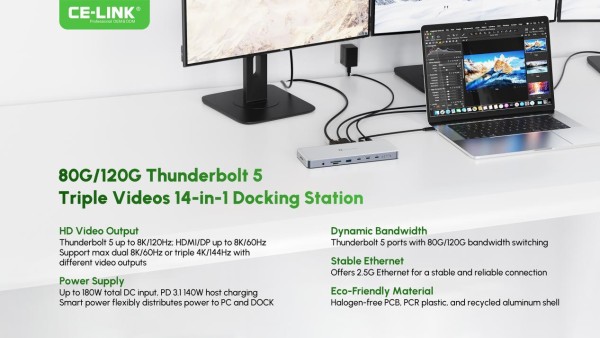
Dongguan, Guangdong, China, 13th Jan 2026 – CE-LINK, the world’s leading provider of intelligent connectivity solutions, officially announces the launch of its revolutionary Thunderbolt 5 docking station: the 80G/120G Thunderbolt 5 Triple Video 14-in-1 Docking Station. This groundbreaking product leverages Intel’s latest Thunderbolt 5 technology to elevate the desktop connectivity experience to unprecedented heights, delivering ultimate performance for professional creators, gamers, and enterprise users.

With support for up to 120Gbps dynamic bandwidth, CE-LINK’s latest docking station provides a seamless balance of ultra-high data transfer, multiple 8K video outputs, and reliable power delivery. Built with future-proof versatility, it is fully backward compatible with USB4 v2, USB4, Thunderbolt 4/3, and DP Alt Mode devices, ensuring wide adoption across evolving ecosystems.

Advanced Thunderbolt 5 Performance

The dock is equipped with two downstream Thunderbolt 5 ports, each capable of up to 120Gbps throughput with theoretical support for 8K/120Hz resolution and 15W downstream device charging. Display output ports support video extension up to 8K/60Hz via DP or HDMI. On compatible Windows Thunderbolt 5 laptops, it supports max dual 8K/60Hz or triple 4K/144Hz with different video outputs, creating immersive multi-screen workstations ideal for content creation, data analysis, and entertainment.

Dynamic bandwidth allocation intelligently switches between 80Gbps and 120Gbps based on usage scenarios, ensuring optimal performance whether users are transferring massive files, streaming in 8K, or powering demanding peripherals.

Comprehensive Multi-Port Connectivity

The docking station offers a complete suite of ports tailored for modern workflows:

  • USB-C 10Gbps x2 (one with 30W output for fast device charging)

  • USB-A 10Gbps x1

  • USB-A 5Gbps x2

  • SD/TF 4.0 Card Reader x1

  • RJ45 Ethernet (2.5G) x1

  • 3.5mm Combo Audio Jack x1

  • DC Input 180W (with up to PD3.1 140W host charging)

Notably, the dock features smart power management, dynamically allocating power between the laptop and dock in real time based on the demands of connected devices.

This wide array of connections makes the dock a central command hub for laptops, external drives, displays, audio equipment, and network devices.

Designed for Sustainable Development

Beyond high performance, CE-LINK designed the docking station with environmental responsibility in mind. The PCB uses halogen-free materials, the plastic housing is crafted from PCR (post-consumer recycled) materials, and the aluminum shell is made from recycled aluminum—a commitment to sustainable product development without compromising durability.

For added security, the dock integrates a K-Lock slot, making it suitable for office and enterprise environments where device protection is essential.

For more information about CE-LINK and its products, please visit www.ce-link.com or contact market@ce-link.com.

About CE-LINK

Founded in 2004, CE-LINK is a leading OEM and ODM company dedicated to developing innovative digital connectivity products. The portfolio spans docking stations, adapters, charging devices, and more, with products distributed to over 70 countries and regions worldwide. CE-LINK remains committed to technology-driven innovation and user-centric design, delivering premium connectivity experiences to customers globally.
Website: www.ce-link.com

LinkedIn: www.linkedin.com/company/ce-link

Facebook: www.facebook.com/CELINK.ELECTRONICS

YouTube: www.youtube.com/@ce-linkelectronics3909


Media Contact

Organization: CE LINK LIMITED

Contact Person: CE-LINK

Website: https://www.ce-link.com/

Email: Send Email

City: Dongguan

State: Guangdong

Country:China

Release id:40106

The post CE-LINK Unveils Next-Gen 80G – 120G Thunderbolt 5 Triple Videos 14-in-1 Docking Station appeared first on King Newswire. This content is provided by a third-party source.. King Newswire makes no warranties or representations in connection with it. King Newswire is a press release distribution agency and does not endorse or verify the claims made in this release. If you have any complaints or copyright concerns related to this article, please contact the company listed in the ‘Media Contact’ section

file

Manex3D makes AI 3D model generation accessible to everyone. Generate professional 3D models from images or text prompts instantly.

United States, 13th Jan 2026 – Manex3D, an innovative AI-driven 3D modeling platform, officially launches today. It offers creators, designers, and businesses a new way to generate 3D models with AI. The platform is powered by advanced models to convert both images and text prompts into high-quality 3D models within minutes.

The launch addresses people’s demand for accessible and easy-to-use AI 3D content creation tools. The platform can benefit people across industries including gaming, e-commerce, virtual reality, product design, and digital marketing. 

Manex3D offers two primary AI 3D model generation services:

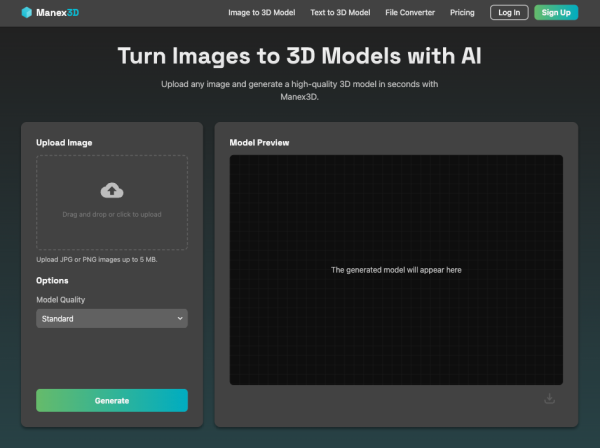
Image to 3D: Users can upload a single image, and Manex3D analyzes the visual data to construct a corresponding 3D model, complete with textures and geometry that capture the original subject’s depth and form.

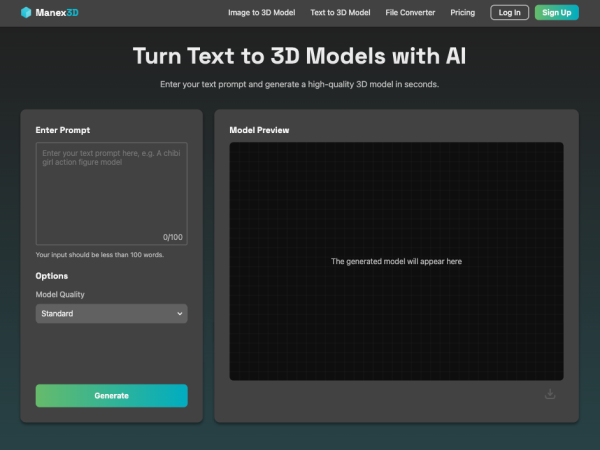
Text to 3D: Through natural language processing, Manex3D’s AI can understand users’s descriptions of objects or scenes in plain text, and then generate a 3D model matching the description. This opens creative possibilities and convenience for concept visualization and rapid prototyping.

“We’re excited to bring Manex3D to market at a time when AI is becoming a more important role in 3D modelling,” said Roger Chen, co-founder of Manex3D. “Our mission is to remove the technical barriers that have traditionally limited 3D creation to specialists. Whether you’re a professional or an enthusiast, Manex3D makes AI 3D modeling accessible to everyone.”

Manex3D is free to try, with different subscription tiers designed to accommodate individual creators, small teams, and enterprise clients. If you’re interested, try it for free at https://manex3d.com/.

About Manex3D

Manex3D is a web-based platform that uses AI to generate 3D models from images and text prompts. The company’s mission is to democratize 3D content creation by making professional-quality AI modeling tools accessible to users regardless of technical expertise.

Media Contact

Organization: Manex3D

Contact Person: Roger Chen

Website: https://manex3d.com/

Email: Send Email

Country:United States

Release id:40105

The post Manex3D Launches Its AI 3D Model Generation Platform appeared first on King Newswire. This content is provided by a third-party source.. King Newswire makes no warranties or representations in connection with it. King Newswire is a press release distribution agency and does not endorse or verify the claims made in this release. If you have any complaints or copyright concerns related to this article, please contact the company listed in the ‘Media Contact’ section

file

BATUMI, Georgia, 12th Jan 2026 — Seaside Georgia, a real estate consultancy and advisory firm based in the Adjara region, today announced an expansion of its project portfolio and the introduction of a new service framework. The initiative is intended to facilitate international participation in the coastal residential and hospitality sectors of Georgia.

This operational growth follows a period of increased activity along the Black Sea coast, specifically within Batumi, Gonio, and Kobuleti. Seaside Georgia’s updated operations will prioritize developments that adhere to international construction standards and sustainable urban planning protocols.

“As the Georgian Black Sea coast continues to grow as a destination for tourism and residency, the requirement for transparent, data-driven services has increased,” stated Luka Tskhadadze, co-founder of the company.

The rollout includes an expanded suite of advisory services designed to assist clients through the property acquisition process, including legal due diligence, architectural assessment, and property management. This “single-window” approach is intended to address the procedural requirements of cross-border real estate transactions.

Seaside Georgia’s new framework also emphasizes infrastructure integration. The firm is focusing on projects located near the Batumi Boulevard expansions and those incorporating sustainable technologies, reflecting current trends in buyer preferences for energy-efficient living.

The regional market is supported by Georgia’s economic policies, which include a simplified property registration system and specific tax structures for property owners. Seaside Georgia’s expansion aims to support the local economy by facilitating international transactions and assisting in the development of hospitality infrastructure.

About Seaside Georgia Seaside Georgia is a real estate consultancy and advisory firm operating in Georgia. The company focuses on the Black Sea coastal market, providing services for residential and commercial property transactions. Seaside Georgia provides market analysis and administrative support to international clients navigating the Georgian property sector.

For more information, visit https://seasidegeorgia.ge/.

Media Contact

Organization: Seaside Georgia

Contact Person: Luka Tskhadadze

Website: https://seasidegeorgia.ge/

Email:
info@seasidegeorgia.ge

Contact Number: +995595644849

Country:Georgia

Release id:40113

The post Seaside Georgia Announces Strategic Expansion of Portfolio to Meet Growing International Demand for Black Sea Real Estate appeared first on King Newswire. This content is provided by a third-party source.. King Newswire makes no warranties or representations in connection with it. King Newswire is a press release distribution agency and does not endorse or verify the claims made in this release. If you have any complaints or copyright concerns related to this article, please contact the company listed in the ‘Media Contact’ section

file

Birmingham, Alabama, 12th January 2026, ZEX PR WIRE, In a digital environment saturated with ads, automation, and algorithmic decision making, many brands struggle to create campaigns that truly resonate. Clicks are easier to buy than trust, and impressions are no longer a reliable indicator of impact. Suha Atiyeh, a marketing strategist based in Birmingham, Alabama, believes this disconnect stems from a missing ingredient: emotional intelligence. Her work argues that lasting campaigns are not built solely on data or creativity in isolation, but on a deep understanding of human motivation supported by insight and empathy.

With more than a decade of experience guiding brands through periods of growth and transformation, Suha has developed a reputation for designing strategies that feel personal while delivering measurable results. Her approach challenges the idea that performance marketing and emotional resonance are opposing forces. Instead, she positions them as complementary disciplines that, when aligned, create campaigns that stick.

Moving Beyond Metrics Without Ignoring Them

Data remains central to Suha’s methodology, but she is careful to define its role. Numbers, in her view, explain what people do, not why they do it. Campaigns that rely only on dashboards and attribution models often optimize for short term gains while missing the emotional signals that shape long term loyalty. Suha encourages brands to use data as a starting point rather than a final answer.

In practice, this means pairing quantitative insights with qualitative research, customer interviews, behavioral patterns, and cultural context. By examining how audiences feel at different stages of the customer journey, Suha helps brands design messaging that aligns with real emotional needs. The result is marketing that feels intuitive to the audience while remaining accountable to performance goals.

Building Brand Narratives That Feel Human

Storytelling is a cornerstone of Suha Atiyeh’s work, but not in the abstract sense often associated with branding. She focuses on narratives that reflect the lived experiences, frustrations, and aspirations of the audience. For Suha, effective brand stories are not about self-promotion, they are about recognition. When customers see themselves in a campaign, engagement becomes a natural response rather than a forced outcome.

Her experience spans fast growing SaaS companies and established consumer brands, giving her insight into how storytelling must adapt across industries. In each case, she emphasizes clarity over cleverness and sincerity over spectacle. Campaigns succeed, she notes, when brands communicate with audiences rather than at them.

Emotionally Intelligent Campaign Design

Emotionally intelligent marketing requires intention at every stage of campaign development. Suha begins by defining not just the business objective, but the emotional outcome a brand wants to achieve. Whether the goal is confidence, reassurance, curiosity, or belonging, that emotional target shapes creative direction, channel selection, and performance benchmarks.

This framework allows campaigns to maintain consistency across platforms without becoming repetitive. Messaging adapts to context while preserving emotional coherence. According to Suha, this alignment is what transforms multi-channel efforts into unified brand experiences. Customers may encounter a brand through different touchpoints, but the emotional impression remains intact.

Balancing Performance Marketing With Long Term Trust

One of the challenges many brands face is the pressure to demonstrate immediate returns. Suha acknowledges this reality while cautioning against strategies that sacrifice trust for speed. Emotionally intelligent campaigns are designed to perform, but they are also built to age well. They leave room for relationship building rather than treating every interaction as a transaction.

By integrating brand positioning with performance marketing, Suha helps clients avoid the cycle of constant reinvention driven by short term metrics. Instead, campaigns evolve organically, guided by audience feedback and market signals. This balance has enabled her clients to achieve consistent growth in engagement and market share without eroding brand equity.

Lessons From Digital Transformation Projects

Throughout her career, Suha Atiyeh has guided organizations through complex digital transformations. These projects often involve more than new tools or platforms, they require shifts in mindset. Teams accustomed to siloed execution must learn to collaborate around shared emotional and strategic goals.

Suha’s role in these transformations extends beyond campaign strategy. She works closely with leadership to align marketing efforts with broader business values. This alignment ensures that emotionally intelligent marketing is not a one off initiative, but a sustainable practice embedded in the organization’s culture.

Advocacy for Authentic Connection in Marketing

At the core of Suha’s philosophy is a belief that authenticity cannot be manufactured. Audiences are increasingly adept at recognizing performative messaging, especially in digital spaces. Emotionally intelligent marketing demands honesty, even when it requires brands to acknowledge limitations or challenges.

Suha advises brands to view vulnerability as a strategic asset rather than a liability. Transparent communication fosters credibility, and credibility creates the conditions for loyalty. Campaigns rooted in authenticity may not always generate viral moments, but they build the kind of trust that supports long term growth.

Investing in the Next Generation of Marketers

Beyond her client work, Suha is deeply engaged in mentoring emerging marketing professionals in Birmingham’s growing tech and creative ecosystem. Through her involvement with Innovation Depot and a local arts non-profit, she contributes to shaping a new generation of marketers who value empathy alongside expertise.

She encourages young professionals to develop both analytical rigor and emotional awareness. In her view, the future of marketing belongs to those who can interpret data without losing sight of the people behind it. This commitment to education and community reflects her broader belief that emotionally intelligent marketing starts with emotionally intelligent leaders.

Birmingham as a Creative and Strategic Hub

Suha Atiyeh’s work is closely tied to Birmingham, a city she views as an emerging hub for innovation and creativity. The collaborative spirit of the local business community has influenced her approach to strategy and partnership. She believes regional markets offer valuable lessons in authenticity and connection that global brands can learn from.

By remaining rooted in Birmingham while working with clients across industries, Suha demonstrates that impactful marketing leadership is not confined to traditional coastal centers. Her success highlights the role of diverse perspectives in shaping more inclusive and emotionally aware marketing practices.

Redefining What Makes Campaigns Stick

As marketing continues to evolve, Suha Atiyeh’s case for emotionally intelligent strategies offers a compelling framework for the future. Campaigns that stick are not defined by novelty alone, but by relevance, resonance, and respect for the audience. They acknowledge emotion as a driver of decision making and treat data as a tool for understanding rather than manipulation.

Through her work, Suha shows that emotionally intelligent marketing is both principled and practical. It delivers results while honoring the human experience behind every metric. In a crowded digital landscape, this balance may be what ultimately separates campaigns that are seen from those that are remembered. For Suha Atiyeh, this philosophy is not a trend but a long term commitment to building brands that understand people before persuading them.

About Suha Atiyeh

Suha Atiyeh is a Birmingham, Alabama based marketing strategist with more than a decade of experience helping brands translate insight into impact. Known for blending data driven strategy with emotionally intelligent storytelling, Suha Atiyeh has worked with a wide range of organizations, from fast growing SaaS companies to established consumer brands, guiding them through periods of growth, repositioning, and digital transformation. A graduate of the University of Alabama at Birmingham with a B.S. in Marketing, Suha Atiyeh is also an active mentor within the local tech and creative community and serves on the board of a nonprofit arts organization.

Doha, Qatar, 12th Jan 2026 – Gem Soft, a provider of messaging infrastructure, announces its all-in-one B2B platform Gem Team, addressing fragmented and insecure communication issues. Backed by Gem Soft’s expertise, Gem Team offers unified chat, voice, video, file sharing, and collaboration, secured with ISO 27001 compliance, multi-layer encryption, and data sovereignty via on-premise or cloud deployment.

Amid rising data breaches and regulations, Gem Team includes resilience features: air-gap deployment, granular controls, audit trails, and auto-deletion. Video supports up to 300 participants with screen sharing, call recording, and moderation tools. The user experience includes editable messages, real-time status, unlimited storage, and 24/7 support, depending on the package option.

Standout AI tools: embedded assistants, multi-agent systems, RAG pipelines, fine-tuned LLMs for enterprise tasks. Developed under an SSDLC with penetration testing, Gem Team serves GCC sectors like government, finance, healthcare, and Qatar Vision 2030 initiatives.

Gem Team provides security features and customizable AI for enterprise operations. It enables data sovereignty and innovation.

About the Company

Gem Team is an all-in-one B2B platform by Gem Soft that unifies chat, voice, video, file sharing, and collaboration, with strong security (ISO 27001, multi-layer encryption) and flexible deployment for data sovereignty (on-premise or cloud), plus built-in AI tools like assistants, RAG pipelines, and fine-tuned LLMs for enterprise tasks.

Gem Team Site.

Media Contact

Organization: Gem Soft

Contact Person: Michael Jordan, CEO

Website: https://gem.team/

Email: Send Email

Contact Number: +97470135965

Address:Address: Office No. 226-02, Floor No. 2 Regus Business Centre, No. 65

City: Doha

Country:Qatar

Release id:40097

The post Gem Soft Introduces Gem Team: A Secure, AI-Enhanced Unified Communications Platform for Enterprises appeared first on King Newswire. This content is provided by a third-party source.. King Newswire makes no warranties or representations in connection with it. King Newswire is a press release distribution agency and does not endorse or verify the claims made in this release. If you have any complaints or copyright concerns related to this article, please contact the company listed in the ‘Media Contact’ section

file

Johannesburg, South Africa – As South Africa’s finance and insurance sectors move into 2026, one reality is becoming increasingly clear: recruitment is no longer a support function. It is a material business risk.

In industries shaped by strict regulation, heightened performance pressure and reputational exposure, the cost of hiring mistakes has never been higher. For finance and insurance businesses, people are not only operational assets — they are the frontline of compliance, customer trust and brand credibility.

From contact centres and claims departments to sales, administration and support functions, the quality and reliability of talent directly underpin operational stability. In this environment, partnering with the right recruitment provider is no longer a “nice to have”; it is a strategic safeguard.

The Cost of Hiring Mistakes in High-Risk Environments

Unlike many other sectors, poor hiring decisions in finance and insurance carry layered and far-reaching consequences. A single underqualified or poorly vetted employee can trigger compliance breaches, customer complaints, financial losses and reputational damage that extends well beyond one role or department.

In 2026, these risks are amplified by:

  • Increased regulatory scrutiny and governance expectations
  • More informed consumers with lower tolerance for service failures
  • Intensifying pressure on contact centres to resolve issues faster and at scale
  • Persistently high turnover in entry-level, claims and sales roles

When turnover is high and roles are business-critical, rushed recruitment processes and overstretched internal teams create vulnerability. Hiring becomes reactive, screening quality declines and performance suffers.

Talent Shortages and Turnover Remain Ongoing Challenges

Finance and insurance organisations continue to compete for a limited pool of skilled, dependable talent, particularly in customer-facing and operational roles. Burnout, aggressive poaching and performance pressure have made retention as challenging as attraction.

Internal HR teams are often required to manage compliance, employee relations, performance management and recruitment simultaneously. This frequently results in delayed hiring, reduced screening depth and increased exposure to risk.

This is where a specialist recruitment partner delivers measurable value.

Why Internal Hiring Alone Is No Longer Enough

While internal recruitment teams remain essential, they are rarely structured for high-volume hiring, rapid turnaround or sustained talent pipelining — particularly in high-pressure, regulated environments.

A specialist recruitment agency provides:

  • Dedicated sourcing capacity
  • Pre-screened, role-ready talent pools
  • Industry-specific vetting and compliance processes
  • Speed without compromising on quality

Most importantly, a recruitment partner introduces accountability. Outcomes are measured, delivery is tracked and performance matters.

The Strategic Value of a Specialist Recruitment Partner

In finance and insurance, recruitment should actively reduce risk — not introduce it. A recruitment partner with deep sector expertise can anticipate challenges before they become operational issues.

The right partner does more than fill vacancies. They:

  • Understand compliance and governance requirements
  • Assess candidates beyond CVs, prioritising reliability, integrity and performance
  • Enable scalable hiring during peak demand periods
  • Offer staffing flexibility through contract, temporary and permanent placements

How Isilumko Staffing Supports Finance and Insurance Businesses

Isilumko Staffing partners with finance and insurance organisations to deliver recruitment solutions that prioritise quality, compliance and business continuity.

With proven experience in high-volume, regulated environments, Isilumko Staffing provides:

  • Comprehensive screening and vetting aligned with industry standards
  • Access to pre-qualified talent pools across contact centre, administration, claims and support roles
  • Flexible staffing models that adapt to changing business needs
  • Clear accountability and performance-driven delivery

Guided by values of ownership, integrity and exceptional performance, Isilumko Staffing operates as an extension of its clients’ businesses — not merely a supplier.

Recruitment as Risk Management in 2026

In 2026, finance and insurance organisations can no longer afford recruitment shortcuts. Talent decisions have a direct impact on compliance, customer trust and bottom-line performance.

Choosing a recruitment partner such as Isilumko Staffing is not about outsourcing hiring — it is about strengthening it. With the right partner in place, recruitment becomes a protective layer, enabling organisations to operate with confidence in an increasingly complex landscape.

For more information or to discuss your 2026 recruitment needs, please contact:

Virgilene Moodley
Sales Director – Isilumko Staffing
Phone: 011 267 2920
Mobile: 082 300 7590
Website: www.isilumko.co.za

Media Contact

Organization: Isilumko Staffing

Contact Person: Virgilene Moodley

Website: https://isilumko.co.za/

Email: Send Email

Contact Number: +27113166640

Address:Unit C5, Mount Royal, 657 James Crescent, Halfway House, Midrand, 1685

Address 2: Unit G, La Rocca, 321 Main Road, Bryanston, Johannesburg, 2195

City: Johannesburg

State: Gauteng

Country:South Africa

Release id:39961

The post Isilumko Staffing Strengthens Finance and Insurance Recruitment Capabilities for 2026 appeared first on King Newswire. This content is provided by a third-party source.. King Newswire makes no warranties or representations in connection with it. King Newswire is a press release distribution agency and does not endorse or verify the claims made in this release. If you have any complaints or copyright concerns related to this article, please contact the company listed in the ‘Media Contact’ section

file

From Compliance Consensus to Industrial Implementation, Web3 Officially Enters a New Era of Large-Scale Applications

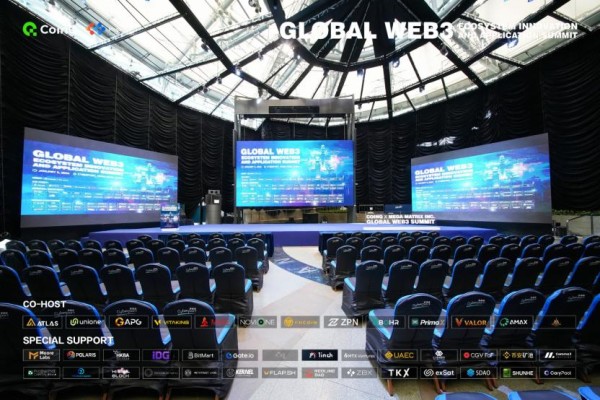
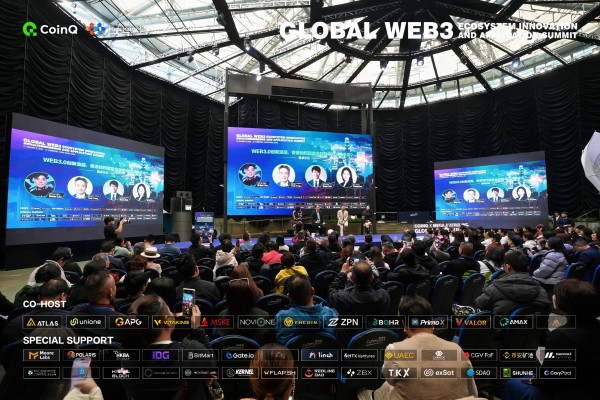
China, 12th Jan 2026 – On January 5, 2026, the “Global Web3 Ecosystem Innovation & Application Summit” was successfully held at Cyberport Hong Kong. On the day of the summit, Cyberport Hong Kong was bustling with crowds, creating a lively atmosphere. According to statistics, the on-site attendance exceeded a thousand people, attracting blockchain practitioners, investment institution representatives, exchange executives, technical developers, and media professionals from various countries and regions around the world, including China, Hong Kong, China, the United States, Vietnam, South Korea, Malaysia, Singapore, Thailand, Germany, and Dubai. Such a diverse international lineup fully demonstrates Hong Kong’s strong appeal as a global hub for Web3 innovation, as well as the summit’s extensive influence within the industry.

The event was co-hosted by CoinQ Exchange and U.S.-listed Mega Matrix Inc., with dozens of co-organizers including Atlas, UniOne, VITAKING, MSKE, NoviOne, FHCoin, ZPN, BOHR, and PrimoX. It received special support from over twenty top-tier industry institutions such as Moore Labs, Polaris, Hong Kong Blockchain Association (HKBA), BitMart, Gate, ABCDE Capital, 1inch Network, and HTX Venture. Core blockchain media outlets including ME, Planet Daily, Rhythm BlockBeats, Chain Catcher, PANews, and Foresight News provided in-depth coverage throughout the event, collectively witnessing this feast of intellectual exchange and resource networking.


From “Proof of Concept” to “Real World”: The Key Turning Point of Web3

The global digital economy is now entering a new phase of structural transformation. Blockchain and Web3 technologies are moving beyond their early ‘proof-of-concept’ stage, which was primarily driven by technical narratives, and are now addressing core issues such as compliance, efficiency, practical applications, and business sustainability.
Against this backdrop, the Global Web3 Ecosystem Innovation and Application Summit holds significant contemporary relevance. With its core theme ‘Ecosystem Innovation × Practical Applications’, the event clearly signals a key industry trend:
The next phase of Web3 competition will no longer focus on isolated technological breakthroughs, but rather on the contest of systemic industrial capabilities.


Important Speech and Speech, Outline the Clear Industrial Context

The opening address at the summit was delivered by Shi Yuhua, an investor at CoinQ exchange. His speech began with an analysis of the industry’s macro cycle, highlighting that Web3 is entering a new phase where compliance capabilities and ecosystem synergy are at the core.

Subsequently, Colin Butler, founder of Mega Matrix Inc. (NASDAQ: MPU), elaborated on the practical logic of how Web3 technology is progressively integrated into mainstream business and financial frameworks from the perspectives of listed companies and global capital markets. This further reinforced the developmental path of Web3 and traditional financial systems, emphasizing their ‘integration rather than opposition.’

Key industry representatives from Hong Kong also contributed practical institutional and industrial insights to the summit.
Thomas Cheung, former National People’s Congress deputy from Hong Kong and partner of Hong Kong Innocent Angel Fund, MH JP

Huo Yuhui, Vice President of the Hong Kong Blockchain Association, elaborated on Hong Kong’s distinctive advantages in the global Web3 landscape, covering policy environment, industrial ecosystem maturity, and international connectivity capabilities.
 

RWA and Compliance Finance: From Hot Topics to Practical Path

Among all topics, RWA (Real-World Assets on the Chain) was undoubtedly one of the most highly discussed areas at this summit.
Tony Tong, CEO of UAEC Dena Trust and founder of HKBA, delivered a presentation on ‘RWA Development Strategies in the Context of Global Compliance Trends,’ which was praised by multiple institutional representatives as ‘both forward-looking and actionable.’
The core argument is that RWA is not merely about digitizing assets, but a systemic endeavor involving legal frameworks, custody mechanisms, clearing systems, and cross-border compliance coordination.
This assessment closely aligns with the observations of multiple institutional investors at the conference, further confirming that RWA is transitioning from conceptual discussions to a stage of scalable implementation.

Roundtable Forum: How Hong Kong Empowers the New Global Web3 Order

The roundtable forum, moderated by Brian Lau—partner at Market Across and ambassador for Solana and Binance—featured insights from institutions including Mega Matrix, Gate, BitMart, and Solana. These discussions underscored the accelerating convergence of technology with traditional sectors like finance, entertainment, and mining, emerging as a pivotal hub for intellectual exchange at the summit. Participants widely acknowledged that Hong Kong is evolving into a unique nexus bridging regulation, capital, and technological innovation, positioning it to serve as a “institutional infrastructure” in the future global Web3 landscape.
 

Project Roadshow: Real Application Becomes Core Competitiveness

A series of Web3 projects showcased their real-world industrial applications. Innovations like BOHR, ZPN privacy public chain, MSKE inscription, NoviOne payment solution, VITAKING’s gold mining asset tokenization, and Unione’s StoreFi ecosystem took turns to demonstrate Web3’s commercial potential across diverse verticals. Keywords such as’ verifiable computing power, ” entertainment RWA, ‘and’ stablecoin payments’ drew significant on-site attention.
Meanwhile, the exhibition showcased projects spanning multiple Web3 sectors including cultural and entertainment industry RWA, privacy-focused public chains, inscription ecosystems, stablecoin payments, StoreFi, and DeFi infrastructure, clearly demonstrating the emergence of a multi-tiered and collaborative industrial ecosystem in Web3.

Web3 officially enters the era of application-driven from Hong Kong

In summary, this Global Web3 Ecosystem Innovation and Application Summit transcends being merely a showcase of technologies or projects—it has evolved into a platform for the industry to collectively articulate its shared vision.
As compliance becomes the prerequisite, application the core, and ecosystem the key, Web3 is rapidly entering a new phase with more tangible anchors and enduring value logic.
Leveraging its institutional strengths, global connectivity, and industrial foundation, Hong Kong is steadily establishing itself as a strategic pivot in the global Web3 landscape.


Media Contact

Organization: CHINA SHUNHE GROUP CO., LIMITED

Contact Person: Alice

Website: https://zpnchain.io/

Email: Send Email

Address:RM 21 UNIT A 11/F TIN WUI IND BLDG NO 3 HING WONG ST TUEN MUN NT HONG KONG

Country:China

Release id:40082

The post Global Web3 Ecosystem Innovation and Application Summit Concludes Successfully in Cyberport, Hong Kong appeared first on King Newswire. This content is provided by a third-party source.. King Newswire makes no warranties or representations in connection with it. King Newswire is a press release distribution agency and does not endorse or verify the claims made in this release. If you have any complaints or copyright concerns related to this article, please contact the company listed in the ‘Media Contact’ section

file

Dubai, United Arab Emirates, 12th January 2026, ZEX PR WIRE, GISEC Global, the Middle East and Africa’s leading cybersecurity event, will participate in the Cyber Run & Ride, a community-led initiative taking place in Abu Dhabi on 17–18 January 2026, reinforcing the importance of cyber awareness beyond the workplace and into everyday life.

Hosted by the Abu Dhabi Sports Council and sponsored by the UAE Cybersecurity Council, the Cyber Run & Ride combines running and cycling activities with a broader mission to promote healthy lifestyles while raising awareness around technology, digital responsibility, and online safety. The event brings together professionals, families, fitness enthusiasts, and the wider community in a shared commitment to safer digital behaviour.

GISEC Global’s participation reflects its belief that cybersecurity awareness must extend beyond boardrooms, policies, and technical forums and become embedded within society and culture. By supporting initiatives such as the Cyber Run & Ride, GISEC continues to advocate for a holistic approach to cyber resilience, where individuals play an active role alongside governments and organisations.

“Cybersecurity is no longer a niche or purely technical concern. It affects how we live, work, and connect every day,” said Alex Nicholl, Vice President, New Industries, at Dubai World Trade Centre. “By taking part in initiatives like the Cyber Run & Ride, GISEC Global is helping to bring cyber awareness into the community, reinforcing that digital safety starts with informed individuals and collective responsibility.”

Participants at the event will be able to take part in running races on 17 January across multiple distances, including half-marathon, 10km, 5km, and 2.5km, while cycling participation will be offered in a non-timed format on 18 January. To register and find out more about the routes, go here.

They will also be encouraged to engage with cyber awareness activities that highlight practical steps individuals can take to protect themselves online, from safe password practices to recognising digital threats. The initiative underscores how small, informed actions can contribute to broader digital resilience.

The Cyber Run & Ride aligns closely with GISEC GLOBAL’s wider mission to serve as a platform for collaboration across the cybersecurity ecosystem. From global policy discussions and technical innovation to public-facing awareness initiatives, GISEC continues to support efforts that strengthen cyber preparedness at every level of society.

GISEC Global will next convene the international cybersecurity community at GISEC Global 2026, taking place from 5–7 May 2026 at Dubai Exhibition Centre (DEC), Expo City Dubai, bringing together global leaders, innovators, and decision-makers to address the most pressing cyber challenges shaping the digital future.


About Dubai World Trade Centre (DWTC):

A global business facilitator since 1979, Dubai World Trade Centre (DWTC) is home to the region’s leading purpose-built convention and exhibition centre. DWTC provides a platform for connecting people, products, innovation and ideas from around the world through a dynamic calendar of international trade exhibitions and its own roster of sector-leading mega events. As a designated free zone, complemented by award-winning commercial real estate, DWTC plays an integral role in Dubai and the region’s growth story. Since its inauguration, DWTC has hosted over 6,000 events, with an estimated economic output of AED 248 billion, attracting over 38 million business visitors to Dubai.

Building on this legacy, DWTC’s second flagship venue, the Dubai Exhibition Centre (DEC), stands as a premier destination for prominent national and international mega events. Strategically aligned with the Dubai 2040 Urban Master Plan, DEC’s recently announced AED 10 billion expansion is integral to Expo City Dubai’s vision of becoming a global business hub for exhibitions and events.

Media Contact:

Jane Oneill – PR Manager

Jane.oneill@dwtc.com


Follow GISEC Global on social media: Facebook | X | Instagram | LinkedIn | Youtube